For context, please see the LinkedIn post by Stuart Bernstein – from Solve for (x).
Image from there too.
Somewhat longer read, no AI.
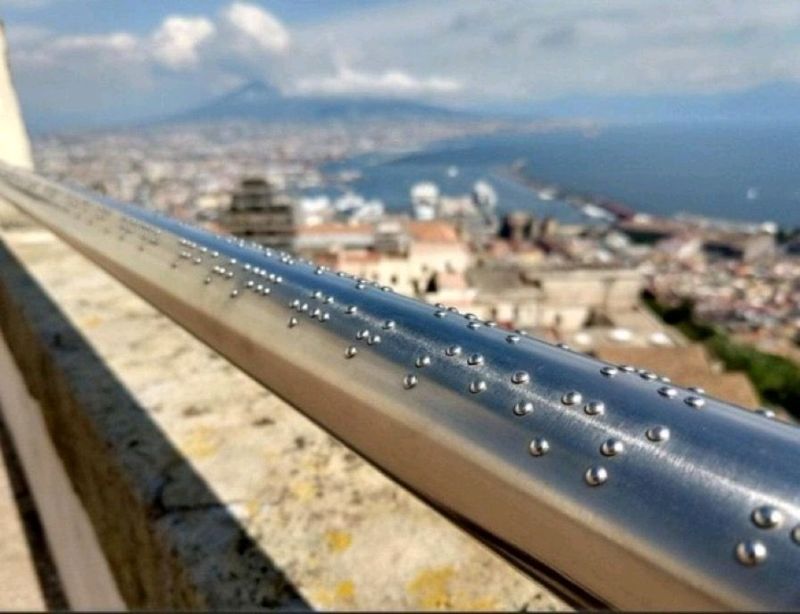
The LinkedIn post and image above brought me the reminder/awareness for inclusion, and contemplation about the visual stimulation out here – that possible visual awe, how could it be experienced by someone who cannot see (and maybe not hear either)?
Let’s imagine getting to that location. The physical experience of the climb there, the gradual feeling of denser and colder air (even if sometimes a small difference), maybe a cooler breeze. Maybe a gradually extended exposure to a different environment. Gradually less urban presence and a denser natural surrounding. The path may not be as straight anymore. The trees may be more present – and leaves more visible in their different shapes and colors; depending on the season they may not even be in the trees, leaving them bare as a reminder of the cycles of prosperity and resilience, or maybe they are in the air floating in the wind around you, or rustling under your steps – someone pushing them around in play with every step, or some kids laughing as they throw leaves in the air and at one-another.
Depending where you are, you may start to notice details, from outside of your usual from the couch or from your daily people-mover routine. You may notice an animal in the more and more exposed natural environment. Like a squirrel going back and forth to a tree and scouting the area, a bird plucking a feather for its nest, a kid playing with a weird shaped branch as if it were a hero’s super-powered accessory…
Some of this can be a hearing experience, some can be a tactile experience – like the wind or the colder, denser air on the skin or the air you breathe. Some of it may be from the person(s) next to you – that notice these kinds of details and points them out to you – maybe sharing their reaction/impression in a way that you didn’t consider at the time – which made you appreciate the moment exponentially more.
It seems to me that we tend to consider the experience of someone that can’t see by picturing them directly from the moment that they are there already at the location and how it would be for them there. But how would they get there, do they know this is accessible for them, or even that it’s an experience that is for them too?
Some people that cannot see (maybe even most) may not need an incentive, or assurance of accessibility, or a calling from outside in order to go to and enjoy such locations and experiences. But I think having an environment that is aware, inclusive, and actually inviting can make such a big difference.
All the wonderful locations and views in the world, many may or may not be inclusive and accessible – but this is usually not reflected in the instagram post with a victory sign and a wink – which seems to be one of the most preponderant representations. Immersed in such a view, while in awe, I think we tend to in a more meditative state, which would seem to attuned with the reaction to the location in the photo above: see/feel the rail with braille > wow, yes people that cannot see should have an extra stimuli that goes along with the murmur of the environment while walking slowly by the rail (hence the so many positive responses to the LinkedIn post).
Someone said the there’s a standard size of the brail dots and that’s an expectation and an ease to have it that way – while I cannot verify this now (I am curios of reactions form actual people that cannot see). Also that only plus minus 10% of people that cannot see know to understand braille. In this context I applaud the effort and appreciate the result even more because I think:
– having ways in which seeing-people have the opportunity to consider and contemplate the blind people is a needed step towards normalizing it and bringing a culture of habit and inclusion.
– It can incentivize blind people that cannot read braille to do start learning and using it to add to the way they navigate and experience life – that sounds like a lot of people that could exponentially enhance their life experience and normalizing and facilitating this makes then even so much more sense if these are the numbers.
– Again, the reaction and perspective of actually someone that cannot see and is involved in advancing the accessibility of braille would be the most valuable in such context.
My perspective is that I’d like (if it isn’t already at least in some experimental segments) for such ways of making the environment accessible/inclusive as normalized as the flexibility of typography that we take for granted (or even ruin it) like having smaller and bigger fonts for different contexts – titles in a banner or poster, italicized quotes, or in this case just one emphasized sentence or verse that follows you along as you walk the vista by the rail.
This has been the reaction of someone that can see, and is probably taking it for granted too often, and has been too neglectful of how many people can be without the privilege of being able to appreciate so many things that so many of us too often take for granted – not just sight, hearing, or physical mobility, but also access to clean water, education and diversity of opinions, freedom of expression, climate control, mobility, technology and other life services and accessories.